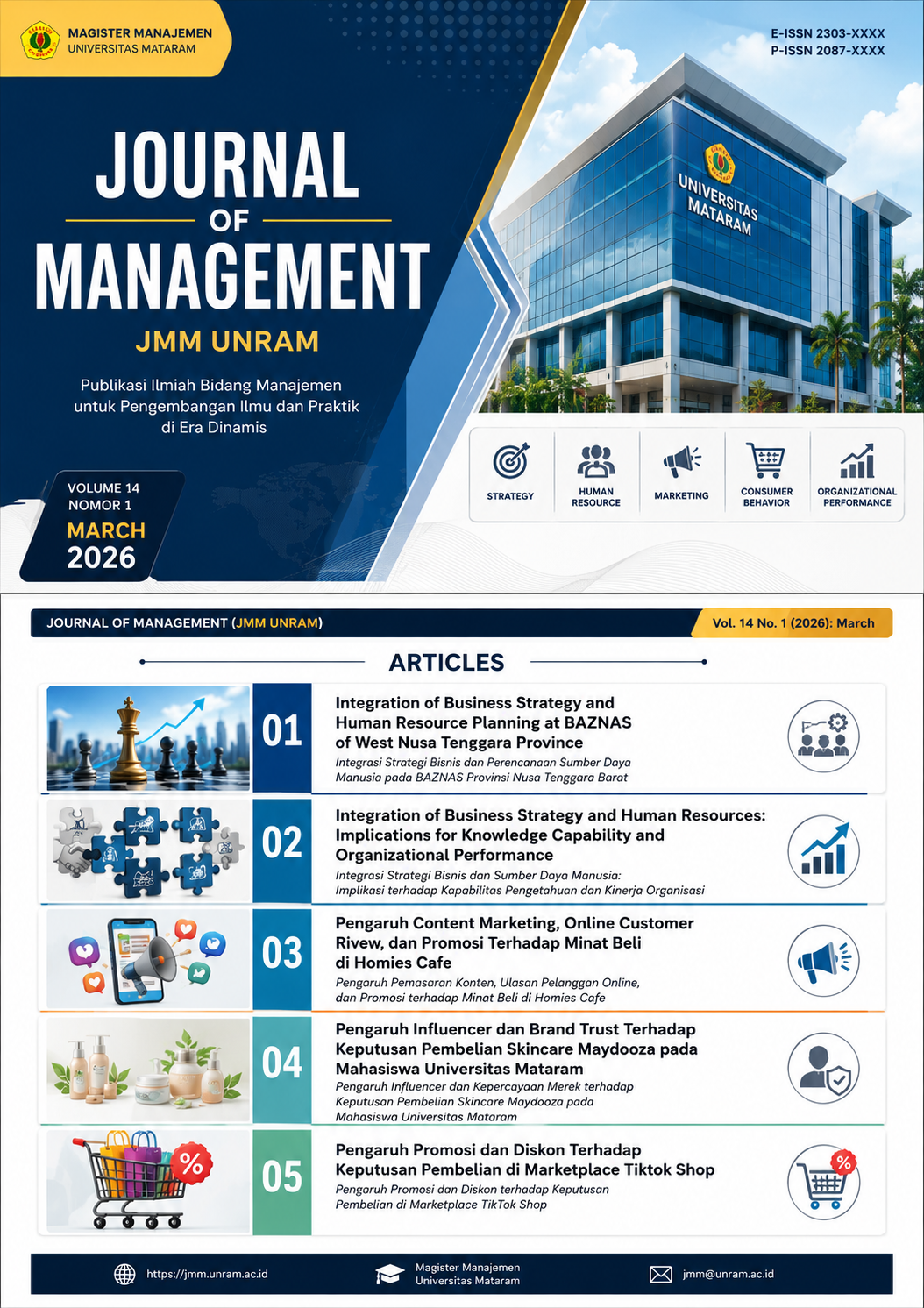
Integration of Business Strategy and Human Resource Planning at BAZNAS of West Nusa Tenggara Province
DOI:
https://doi.org/10.29303/jmm.v14i1.841Keywords:
human resource planning, strategic HRM, knowledge management, zakat management, organizational performanceAbstract
Modern organizational management models position human resources as the strategic element that determines the success of institutional direction and objective implementation. The classical assumption that organizational performance improvement relies solely on formal structure and systems is no longer adequate to explain the complexity of zakat management in the digital era. The integration of Human Resource Planning, Strategic Human Resource Management, and Knowledge Management provides a more comprehensive framework for understanding the relationship among competency, performance, and institutional strategy effectiveness. In the context of BAZNAS (National Zakat Agency) of West Nusa Tenggara Province, changes in the external environment, demands for public transparency, and the acceleration of digitalization affirm the importance of strengthening HR capacity through knowledge–performance mapping, talent development based on strategic needs, and optimization of institutional knowledge. Zakat digitalization programs, mustahik empowerment innovations, and cross-sectoral collaboration demonstrate that HR quality directly impacts the success of organizational transformation. Adaptive HR planning, structured knowledge management, and aligned organizational strategy create a strong foundation for enhancing institutional accountability, operational efficiency, and social impact.References
Abdulaal, A. M., & Nordin, N. (2020). The mediating role of creativity on the
relationship between knowledge management and human resource
management toward innovation performance in the Jordanian SMEs.
International Journal of Innovation Management, 8(1), 12-18.
Abbasi, J., Mehr Ara, A., Bagherzadeh, M., & Matani, M. (2023). Aresearch on the
effectiveness of the strategy and pathology of the human resources planning
system of the social security organization. Journal of Strategic Management Studies,
(56), 293-318.
Afvandi, M., Saphira, R. D., Putra, R. M., Jannah, S. R., Efendi, Z., & Putra, R. B. (2025).
Analisis strategi pengembangan dan perencanaan SDM dalam meningkatkan
kinerja karyawan: Studi kasus pada Geprek Bensu cabang Padang. Jurnal
Mudabbir (Journal Research and Education Studies, 5(1), 855-861.
Ahmed, A., Mahmood, A., Arshad, M. A., & Akhtar, S. (2016). Holistic human
resource development: Balancing the equation through the inclusion of spiritual
quotient. Journal of Human Values, 22(2), 165-179.
Alagaraja, M. (2012). HRD and HRM perspectives on organizational performance: A
review of literature. Human Resource Development Review, 11(2), 125-143.
Alfawaire, F., & Atan, T. (2021). Strategic human resource management (SHRM) and
organizational sustainability. Sustainability, 13(5), 2729.
Alshammari, A. A. (2020). The impact of human resource management practices,
organizational learning, organizational culture and knowledge management
capabilities on organizational performance in Saudi organizations: A conceptual
framework. Revista Argentina de ClÃnica Psicológica, 29(4), 714-721.
Alshamsi, O., & Ajmal, M. M. (2018). Knowledge sharing in technology-intensive
manufacturing organizations: Analytic hierarchy process approach. Business
Process Management Journal.
Al-Tit, A. A., Al-Ayed, S., Alhammadi, A., Hunitie, M., Alsarayreh, A., & Albassam,
W. (2022). The impact of employee development practices on human capital and
social capital: The mediating contribution of knowledge management. Journal of
Open Innovation: Technology, Market, and Complexity, 8(4), 218.
Antara News. (2025, September 1). Bank NTB Syariah gandeng Baznas NTB salurkan
zakat Rp7,2 miliar. Diakses dari
Apostolou, D., & Mentzas, G. (2003). Experiences from knowledge management
implementations in companies of the software sector. Business Process
Management Journal, 9(3), 354-381.
Arifin, Y. (2023). Talent management-based training planning to produce high
performing human resources. Jurnal Ilmiah Ilmu Administrasi Publik: Jurnal
Pemikiran dan Penelitian Administrasi Publik, 13(1), 303-310.
Azizi, M. R., Atlasi, R., Ziapour, A., Abbas, J., & Naemi, R. (2021). Innovative human
resource management strategies during the COVID-19 pandemic: A systematic
narrative review approach.
BAZNAS. (2025). Strategi pengumpulan zakat melalui digital Quick Response Code
Indonesian Standard (QRIS) pada BAZNAS Provinsi Nusa Tenggara Barat.
Diakses dari
BAZNAS Provinsi NTB. (2024, November 15). PJ Gubernur resmikan Rumah Layak
Huni kerjasama BAZNAS dan Bank NTB Syariah. Diakses dari
BAZNAS Provinsi NTB. (2025). Program Zakat Kelompok Usaha Produktif (Z-KUP)
berikan harapan baru untuk mustahik. Diakses dari
Baznas RI. (2025, 7 Mei). Dari Mustahik Menjadi Barista Sukses, Z-Coffee, Inovasi
BAZNAS di Tengah Komunitas Santri Bandung. Diakses dari
Benson, J. B. (2025). The impacts of strategic management on organizational
performance in small businesses (Doctoral dissertation, Florida International
University, Miami, Florida).
Collings, D. G., McMackin, J., Nyberg, A. J., & Wright, P. M. (2021). Strategic human
resource management and COVID-19: Emerging challenges and research
opportunities. Journal of Management Studies, 58(5).
Cho, I. J., Ellinger, A. D., Ellinger, A. E., & Klein, A. (2025). Examining the relationship
between dimensions of organizational learning and firms’ financial and
knowledge performance in the Korean business context. University of Illinois at
Urbana-Champaign.
Drubin, D. G., & Oster, G. (2010). Experimentalist meets theoretician: A tale of two
scientific cultures. Molecular Biology of the Cell, 21, 2099-2101.
Evangelista, P., Kianto, A., Hussinki, H., Vanhala, M., & Nisula, A.-M. (2023).
Knowledge-based human resource management, logistics capability, and
organizational performance in small Finnish logistics service providers. Logistics,
(12).
Firman, A. (2023). Knowledge management implementation and human resource
development on employee performance. Jurnal Manajemen Bisnis, 10(1), 221-234.
e-ISSN: 2621-1971, p-ISSN: 2088-7086.
Gunnigle, P., & Moore, S. (1994). Linking business strategy and human resource
management: Issues and implications. Personnel Review, 23(1), 63-84.
Jonek-Kowalska, I. (2022). Networking of research institutes in Poland as a method of
strengthening open innovation: Genesis and initial effects in the area of
commercialization. Journal of Open Innovation: Technology, Market, and Complexity,
(3), 164.
Kim, H., Jo, Y., & Lee, D. (2021). R&D, marketing, strategic planning, or human
resources? Which CEO career is most helpful for the economic sustainability of
ICT startups in South Korea? Sustainability, 13(2729).
LSP BAZNAS. (2025). Sertifikasi Amil Zakat Se-Indonesia Timur Tahun 2025.
Mihaila, S., & Mura, I. (2022). The importance of recruitment in the development of
human resources strategy and planning. Journal Name, 10(1), February 2022.
ISSN 2344-102X.
Ncoyini, S. S., & Cilliers, L. (2020). Factors that influence knowledge management
systems to improve knowledge transfer in local government: A case study of
Buffalo City Metropolitan Municipality, Eastern Cape, South Africa. SA Journal
of Human Resource Management/SA Tydskrif vir Menslikehulpbronbestuur, 18(0),
a1147.
Nusra Media. (2025, September 17). BAZNAS NTB perluas manfaat, 950 siswa dan
300 pendidik terima bantuan.
Paroli, P. (2024). Implementation of strategic planning as an organizational human
resources management process. Jurnal Ekonomi, 13(1).
Ramadian, A., Nurlinda, D. Z., & Ramadhina, N. (2025). Digital transformation in HR
planning: Adaptation strategies and challenges in the industrial revolution 5.0
era. Jurnal Akuntansi dan Manajemen, 22(1).
Rubenstein-Montano, B., Buchwalter, J., & Liebowitz, J. (2001). Knowledge
management: A U.S. Social Security Administration case study. Government
Information Quarterly, 18, 223-253.
Schuler, R. S. (1992). Strategic human resource management: Linking the people with
the strategic needs of the business. Organizational Dynamics, 21(1), 18–32.
Shi, G., Ma, Z., Feng, J., Zhu, F., Bai, X., & Gui, B. (2025). The impact of knowledge
transfer performance on the artificial intelligence industry innovation network:
An empirical study of Chinese firms.
Suarantb. (2025, June 26). BAZNAS NTB diguyur berbagai program zakat produktif.
Suryatni, M., Hailuddin, H., Nururly, S., Thamrin, S., & Sariwulan, T. (2023).
Evaluation of implementation of organizational culture, leadership, and
employment management. Academic Journal of Interdisciplinary Studies, 12(3),
-66.
Wardhani, W. N. R., Suherman, A., Ariani, D., Nururly, S., & Rahmawati, H. U. (2023).
Analysis of the influence of accounting information system and leadership style
on performance of employees in national poultry farming company. JEMSI
(Jurnal Ekonomi, Manajemen, dan Akuntansi), 9(5), 112-121.
Yadav, R. K., & Dabhade, N. (2013). Human resource planning and audit – a case
study of HEG Limited. International Journal of Scientific and Research Publications,
(6), 1-6.
Yasmin, F., Haider, S. A., Sohail, M., Tehseen, S., Poulova, P., & Akbar, A. (2024). How
does knowledge-based human resource management practices enhance
organizational performance? The mediating role of knowledge workers
productivity. Journal of Infrastructure Policy and Development, 8(14), 9383.
Downloads
Published
How to Cite
Issue
Section
License
Copyright (c) 2026 Iin Santika Agustini, Nia Supiani, Pena Riadien

This work is licensed under a Creative Commons Attribution-ShareAlike 4.0 International License.
- Authors retain copyright and grant the journal right of first publication with the work simultaneously licensed under a CC BY 4.0. This license allows authors to use all articles, data sets, graphics, and appendices in data mining applications, search engines, web sites, blogs, and other platforms by providing an appropriate reference. The journal allows the author(s) to hold the copyright without restrictions and will retain publishing rights without restrictions.
- Authors are able to enter into separate, additional contractual arrangements for the non-exclusive distribution of the journal's published version of the work (e.g., post it to an institutional repository or publish it in a book), with an acknowledgment of its initial publication in JMM.
- Authors are permitted and encouraged to post their work online (e.g., in institutional repositories or on their website) prior to and during the submission process, as it can lead to productive exchanges, as well as earlier and greater citation of published work (See The Effect of Open Access).